Not All VPNs Are Private: What No-Logs Really Means
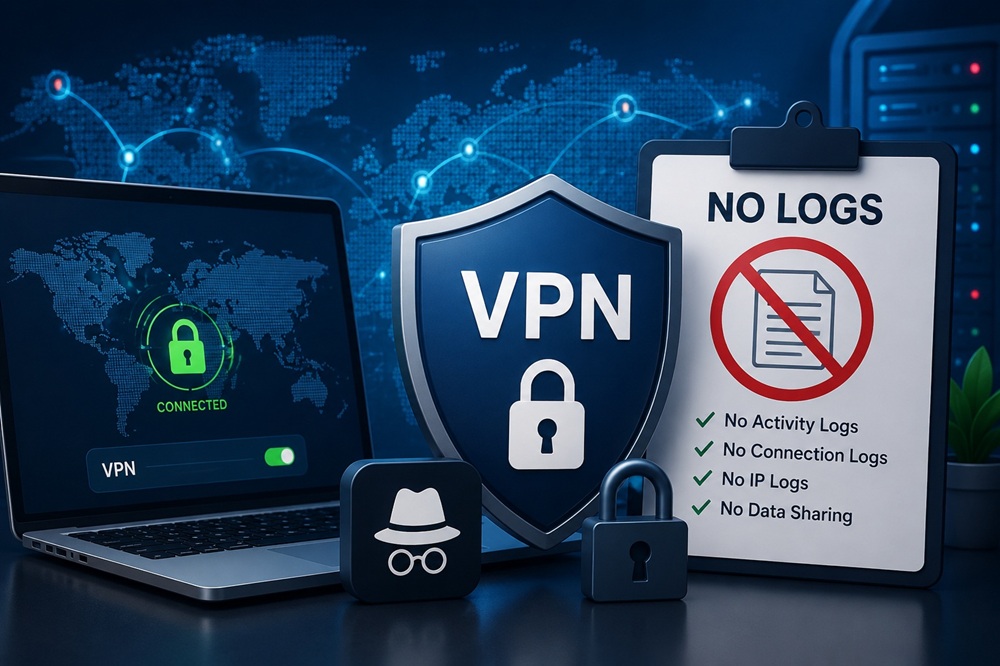
A VPN is often described as a privacy tool, but installing one does not automatically make online activity private. A virtual private network changes who can see certain parts of your internet connection. Your local network and internet provider see an encrypted connection to the VPN server, while websites normally see the VPN server’s public IP address. At the same time, the VPN provider becomes an important part of the trust chain because traffic is now passing through its infrastructure.
That is why “no logs” has become one of the most common claims in VPN marketing. The phrase sounds simple, yet it can mean very different things. One provider may mean it does not store browsing history. Another may still retain connection timestamps, bandwidth totals, device identifiers or account information. A useful privacy assessment therefore starts by asking exactly which data is collected, why it is needed and how long it is retained.
No-logs does not mean no data at all
Every subscription service needs some information to operate. An account may require an email address, payment record or customer-support history. Apps may collect crash reports or diagnostics. Servers also need temporary operational data to handle connections. The key distinction is between information required to run the service and records that could be used to reconstruct a user’s browsing activity or connection history later.
A strong privacy policy should explain those categories clearly. Vague wording such as “we respect your privacy” is not enough. Look for specific statements about source IP addresses, assigned VPN IP addresses, DNS requests, browsing activity, timestamps and session duration. If a provider collects aggregated performance data, it should explain whether that data can be associated with an individual account.
Independent audits are useful — within limits
Some VPN companies hire independent security firms to review infrastructure or test whether logging practices match public claims. That is more meaningful than relying on marketing alone because an external team gets an opportunity to inspect systems and procedures. Still, an audit is a snapshot. Its value depends on what was examined, when it was performed and whether the published report gives enough detail to understand the scope.
Regular audits are generally more reassuring than a single report from many years ago. It is also useful to distinguish between a privacy-policy audit and a security assessment. A penetration test may show that an app or server configuration is resilient to certain attacks, but it does not necessarily prove that the company stores no identifying connection data.
Technology still matters
Privacy policies are only one part of the picture. A well-designed VPN should use modern, well-regarded protocols and protect DNS requests from leaking outside the tunnel. A kill switch can reduce the chance of traffic falling back to the normal internet connection if the VPN disconnects unexpectedly. Apps should also request only permissions that make sense for their features.
Server architecture can influence data exposure too. Some providers use diskless or RAM-only servers designed so that operational data disappears when the server is powered down or rebuilt. This does not eliminate the need to trust the provider, but it can reduce the amount of persistent information available on an individual server. Clear ownership and a transparent explanation of how the network is managed are also valuable.
When comparing the best vpn for privacy options, look beyond a single badge or slogan. Check what the company says it records, whether those claims have been tested independently, how the apps handle DNS and disconnects, and whether the provider has a history of explaining security incidents openly. Privacy is the result of several controls working together, not one marketing phrase.
A practical privacy checklist
- Read the logging section of the privacy policy, not just the home-page summary.
- Check whether source IP addresses, browsing activity and DNS requests are stored.
- Look for recent independent audits with a clearly defined scope.
- Confirm that the apps offer leak protection and a reliable kill switch where appropriate.
- Review who owns and operates the company and whether that information is easy to verify.
- Consider how you will pay and what account information the service requires.
- Keep the VPN app and operating system updated.
Jurisdiction is sometimes presented as the deciding factor, but it should not be viewed in isolation. The country in which a company is based can affect legal obligations, yet technical design and actual data retention determine what information exists to be requested in the first place. A provider with minimal stored data and well-documented systems may offer a clearer privacy model than one relying only on a favourable-sounding location.
A VPN is one layer, not invisibility
Even a privacy-focused VPN does not make a user anonymous to every service. If you sign into an account, that service still knows which account is being used. Browser cookies, fingerprinting, malware and information you voluntarily share can identify you independently of your IP address. A VPN can protect the network path and reduce some forms of tracking, but it cannot solve every privacy problem on its own.
The most useful way to judge a VPN is therefore to be precise about the threat you are trying to reduce. For public Wi-Fi, encrypted tunnelling may be the priority. For limiting ISP visibility, logging practices become especially important. For general online privacy, the VPN should sit alongside good browser settings, strong passwords, software updates and cautious account habits. No-logs can be an important promise, but only when the details behind that promise are clear enough to verify.